- - -
Executive Producer: Discovery Channel
Joshua C. Berkley
Created by Peter Rees
- - -
- A weekly documentary in which two Hollywood special effects experts,
attempt to debunk urban legends by directly testing them. -
With a narrator, Robert Lee, each episode takes the audience along on an exciting and engaging journey. Researching and testing out myths and theories, further into the seasons also by requests or tips from the audience themselves. As part of the research, I watched two episodes of the series "Jet-Assisted Chevy/Pop Rocks and Soda" and "Mentos and Diet Coke".
- Each episode brings up about two different theories or myths and puts them to the test.
- Using the subject driven as well as the informational and partly actually driven method to tell the story.
- They use archive stills or footage to refer to history or the origin of the myths.
- Interviews with specialists to fill in on the facts and lay a foundation for the theories or myths to bounce off to a conclusion.
- By area specialization the two myths or theories brought up run alongside each other as they plan, structure, perform, put to test and round up with results and conclusions.
PRO´S
- Interesting and fun content.
- A spark of humor.
- Nice slow motions.
- Good combination between sync and other footage.
- In the moment, as an audience, we get to tag along and see the whole process from beginning to end.
- Each episode has a conclusion and solution to the tests.
- Surprises and awakens the audience´s thoughts.
- The narrator´s voice is shooting, clear and makes you pay attention.
- Leaves you with satisfaction, feels like we solved the myths together!
- Which is a great tool to use in the way of engaging the audience, bringing them along on new mysteries and myth and theory solving.
CON´S
- Breaking the fourth wall excessively - by showing the other crew and cameras.
- Following the whole process can drag the time a bit.
- Which may loose some viewers.
-- Because it at times feels a bit slow paced.
Overall it is a very interesting programme, especially for the people who like to know how things work - scientifically etc. And that likes to solve and find answers to mysteries, such as to myths and theories.
I grew up watching this series myself, and it is a series I really enjoy watching. It is a very "easy to watch" series, which is great to reach a wide range audience, in all ages. From children, teenagers, adults and elder people. I like the close-up shots, slow motion shots, as well as detail shots of sparks and splinters. The set up of sync and general shots are often very basic and A4, which is alright because it works. Having the setup clear and clean helps to contrast all of the experimenting and action going on in the frame/on screen. It weighs up for each other's elements.
When it comes to how this series has influenced my own work, it has definitely made me see how balanced, clear, clean and standard can work really well. How combining standard and basic with a few different shots or angles can make a big difference and work really well. It is also very interesting how they manage to make the whole journey exciting from prep, test to results. The actually drives it forward and keeps the audience in their seats. Something that would be very cool to achieve with our documentary. Keep the audience engaged, interested and in their seats following the story.
Laura was born in Boston but now lives in New York working as a director and producer of documentary films. Her parents Patricia (Pat) and James (Jim) Poitras, donated in 2007 twenty million dollars to found The Poitras Centre for Affective Disorders Research. She has two sisters, Christine Poitras, which works as an ESL teacher and Jennifer Poitras a disaster response planner and consultant. Laura has won several awards for her work, such as the 2015 Academy Award for Best Documentary Feature for her latest film - Citizenfour
In-depth background
Growing up Laura did not plan on working within film or television industry. She actually wanted to become a chef, and she even spent several years as a cook at a French restaurant in Boston. It was not until she moved to San Francisco that she lost interest in becoming a chief.
She then started to study at San Francisco Art Institute, working and studying with experimental filmmakers. In 1992, she decided to move to New York to pursue a film career at - The New School for Public Engagement - where she graduated from in 1996, with a bachelor degree.
- - -
"There is nothing I love doing more than filming - my camera is the tool that I use to see the world"
To be one of the Americas most celebrated documentary-makers also brings a lot of responsibility and sometimes consequences. Making documentaries sending dispatches from the nation´s frontier zones, Iraq, Yemen and militarised cyberspace to mention some.
It was Poitras reputation that inspired disaffected former CIA employee, Edward Snowden, to come in contact with her. After exchanging anonymous emails where he hinted at previously unimaginable levels of secret state monitoring. After months of sounding each other by encrypted correspondence, they met up in Hong Kong.
Where Laura filmed him backing up his revelations and outing himself as a whistleblower. This resulted in her newest film "Citizenfour" which was named after Snowden´s online alias. A film she won an oscar for. Snowden however, immediately became one of the world's most wanted men. She was accused of being his collaborator and has been stopped and interrogated by US authorities dozens of times. To protect herself and her sources from around the world, she moved to Berlin.
Art Exhibition
Laura Poitras is a woman who keeps a lot of balls in the air at the same time, additionally to filmmaking she also makes time to be a journalist, winning a George Polk award for reporting, as well as her first solo art exhibition, at Manhatten´s Whitney Museum.
In this way, Poitra´s is unique, as to how it is less common for documentary filmmakers to embrace other styles or do work in other branches such as art or commercial features. Many doc makers don´t move from the film circuit to the more enclosed terrain of modern art.
Astro Noise
Laura´s art show, that refers to an encrypted file Snowden gave to her, as well as the background disturbance of thermal radiation left over from the Big Bang. Astro Noise is a contrast to Poitras earlier work - it has more abstract and ambiguity to it. Laura was on Manhattan´s Upper West side when the planes hit the world trade centre in 2001 - which has been an inspiration for this exhibition.
-It opens with six blown up photographs, it transcripts that they are reprocessed images from encrypted data hacked from Israeli drones.
-In the next room is O´say Can You See, a two-sided video installation: one side shows slowed-down footage from New yorkers gazing at ground zero in the aftermath of 9/11.
- The other side shows grainy images of two prisoners in Afghanistan, hoods over their heads, being interrogated by American soldiers.
The message is clear, everything that is seen in this show - art exhibition - is in some way a consequence of 9/11.
"In film there´s a lot of time that´s that´s not creative, I´m keen to expand, to challenge myself in different ways"
Laura interested me by the way she is so brave and determined to get people's stories out there, and constantly working to reveal or fabricate the reality and truth. She truly puts herself out there and is not even afraid to expose her own name or life to danger or threat.
When it comes to how she has inspired my work on this project, in the way of always keeping in mind the importance of the truth. And that the truth and sometimes hidden reality should always shine through. To make sure that our documentary represents something of reality, presented in the rightful and most honorable way as possible.
After today´s fine cut deadline session, we got some new feedback on our project, we are all really pleased and happy with what we have achieved. Now there is only colour correction and the additional final tweaks left before hand-in on Friday.
Notes
Pull music back a bit when presenter is too low
Change a few images which repeat if possible
Tighten it a bit (a few walks)
End is enjoyable
Material handled well
Clear story - - -
Colour correction
Due to the fact that we shot for two days, the light the second day - cutaway shooting - was very different from the first day. It was much brighter, more misty and dull. Which made it quite challenging to set the right light exposure and get the settings to be the best they could, really tricky. This resulted in the cutaways not being as crisp, clear and natural, instead, they got a very yellow tint to them, almost a vintage kind of look.
This was dealt and handled in premiere by colour correction, and underneath you can see the results.
After the final tweaks had been taken care of as well as the colour correction the final end product, the video was exported Thursday the 5th of May.
To show the differences between the rough cut and the fine cut, we chose to export the rough cut before the feedback from Helen. The rough cut is very rough, with no sound, music or levels edited, as well as no colour corrections has been made and some cutaways - still photos has not been put in yet.
After the feedback session with Helen, we noted down some bullet points on what to look at and change up to craft the doc more into the best end-result as possible.
NOTES Swap interviews Structure needs changing Needs to fit together General commentary can help as long Commentary needs to leave the old behind and move on to a new topic Split up Garreth Put in footage which is being spoken about in Garreth´s interview Positive Feedback The opening Garreth Presenter
Right after the session we sat down and cut the shooting script up in pieces, to then sort it out in a new order so it would be easier to get a visual of the new buíld up and structure of the doc.
- - -
Wednesday 27th of April we met up and sat down to go through the sync assembly. Imogen had written up all the dialogue from the interviews, and we highlighted the parts and bits we wanted to include, and that made the most sense.
Interview with Robert
Interview with Garreth
After going through and agreeing on the bits that were picked out, we roughly cut it out from the interview clips and added it down on the timeline. We had edited the presenter parts, as well as cutaways the day before, so it was just left to put the interview bits in to have the finished rough cut.
- - -
- - - -
We spent two days shooting the documentary, where we only had our presenter for the first day and had to plan around this. Therefore, we decided to shoot all of the presenter bits, with the cutaways with him in them, as well as the actuality interview with one of the specialists from the national trust.
DAY 1
Day two, we shot all of the remaining cutaways needed to fill in the presenter and interview bits. We were under time pressure on this day which challenged us, and we realized how much time has to say when shooting. We wished we had a bit more time the seccond day, but sometimes you just have to work with the time you got, and I will say we ´shot´ the best out of it!
DAY 2
As a part of my role as camera op on our project, I have put together the shot lists and sketched some storyboards to prepare for the shooting days. To get the results we want for the production, I have consulted both producer and director as to plan how the structure and set up of the shots and angles will affect and play out on screen.
SHOT LIST
STORY BOARD
I made sure to be in close dialogue with both of them so we could all agree on what it is we want, how we will do it and how we are going about to get the results we want. It was very important to me that what I proposed was ideas that could be altered and played around with to make the production into one joined vision and goal.
SHOOTING SCRIPT
In our presentation, we also chose to focus on different areas of what would be applicable to our own positions and roles in the production. We had a group meeting where we settled on who were to do what, and then we created the presentation on google drive so we could collaborate easily without sitting together the whole time. This method worked really well, as we also have a group chat to communicate regarding anything to do with our project.
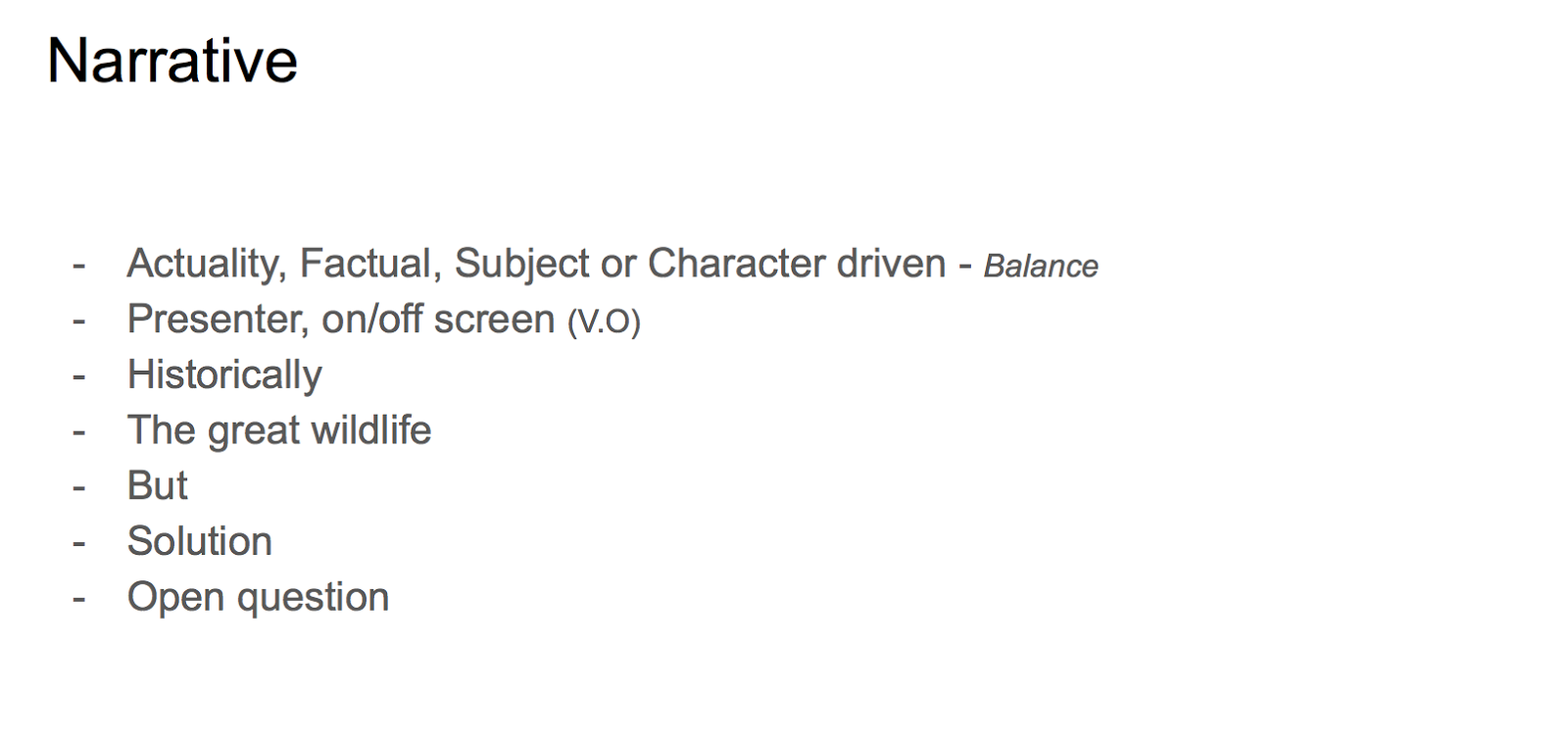
As the projects Camera Op I talked about the narrative of our documentary, and how we picture/are planning on structuring our story. I also talked about the style and cinematography that we are planning on applying to our production.
//Images
From location scouting
//Sources of information
Group - Google drive power point
As a part of the preparation for the documentary, we have all participated in the different areas/roles we have been given. Imogen has written the script (ref: research for the script on her blog) as well as prepared all the paperwork. I am making the shot lists and storyboards (own blog post) with inputs from Rosie. Rosie and I have both posted the casting ad to our CCP - profiles. And we are all going to decide and agree on who get the role as presenter.
THE SCRIPT
CALL SHEET AND SHOOTING SCHEDUAL
RISK ASSESMENT
CALL SHEET
CASTING AD
Each of the applicants had to send in a video audition tape to audition for the role as presenter, for us to be able to decide and know what qualities we will get in out presenter.
In this unit, Documentary, one of the criteria is that our 10-minute long wildlife and nature documentary have to be suitable for transmission at 8pm on UKTV - Wildlife and Nature Channel "Eden"
EdenIs a television channel celebrating nature, wildlife and science´s beauty broadcasting and featuring the very best of BBC´s Natural History Unit with Sir. David Attenborough.
Topics:
- Animals
- Landscapes
- Cutting-edge science
- Life-endangering
As our production has to represent the "Eden" brand and have the Eden audience in mind, I researched their web-page as well as looking at Barb to see the top 10 programs.
Looking at Eden´s channel it has made it clearer and easier to see who exactly is our target age/audience group. Which is going to be very helpful once we move forward with the production.
The first workshop we have had during this unit is an interview workshop where we as the first half of it went through sound recording techniques with Ferg. After that, we had the rest of the day to set up an interview setting, where we were to record pre-made questions that we had prepared. It is really eye-opening to see how much time actually goes into setting up and shooting an interview.
After shooting the interview we got a second task to set up a double interview, interviewing two people at the same time. This turned out to be quite challenging and I learned quite a lot from it, how not tot does it, as well as how to solve it in a better way.
Imogen and I decided to edit it together as our groups got changed around. We edited the interview footage over easter, so it would be ready for completion. To finish it off we shot some cutaway clips on the editing day to put in between the interview clips.
During the workshop, we did run into some challenges regarding the sound when recording to people. This was also because of lack of kit. But we basically worked with what we had to make it work. Another time I would have made sure to kit up with enough kit, as well as using long enough time, like we did under the workshop, to set up to make sure the sound gets right.
It is better to use half an hour to an hour to prepare/set up - be there early and be prepeared.